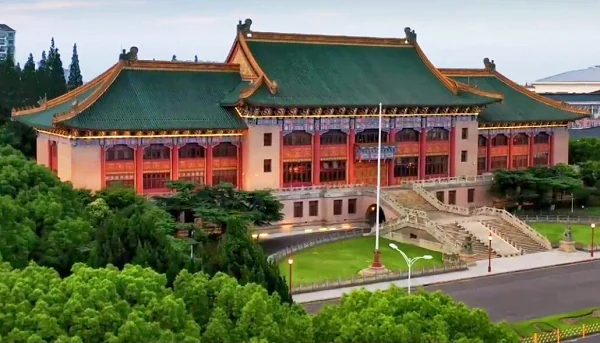
A civic project beyond the famous waterfront
Dong Dayou played a central architectural role in the Greater Shanghai Plan. Tsinghua's historical account connects him with the municipal government building, library, museum and sports facilities in Jiangwan. Shanghai Museum's protected-building guide also identifies him as the designer of Jiangwan Stadium.
This gives you a different set of clients and purposes from a waterfront sequence of banks and hotels. Start by asking what a civic center was meant to gather together: government, public culture and large-scale recreation.
Traditional forms were part of a modern question
Tsinghua's account describes the effort to combine Chinese architectural expression with the needs and construction of modern public buildings. It also notes design adjustments under financial constraints. The historical interest lies in those choices, rather than in a simple claim that a roof makes an entire building traditional.
Look for the relationship between an overall plan and a recognizable architectural gesture. A roofline can announce identity; a layout has to accommodate an institution's work. Asking how the two meet makes the discussion more precise.
A sports ground asks something different of a designer
A stadium is a useful comparison with a library or municipal office. Consider the size of an arriving crowd, the direction of movement and the distance from which an entrance must be legible. Even without going inside, the kind of commission changes the questions you bring.
Do not read a whole civic project from one surviving facade. A plan, a constructed building and its later use are different kinds of evidence. Historical drawings can show ambition; the site can show what was built and changed. Neither should silently stand in for the other.
Treat Jiangwan as a separate visit
The Jiangwan story is geographically distinct from Wukang–Anfu and the Bund. Give it its own research and travel time instead of appending it casually to a central-city walk. Contemporary uses, admission rules and areas that can be visited need checking for the particular building.
For a first reading, place Dong beside Fan Wenzhao and Hudec. Compare commissions before styles: civic institution, theatre, apartment, hotel. That small change of order brings the city's architectural history closer to the people and purposes that produced it.